


Welcome, friends! I’m very excited to share this post with you. It’s based on a chapter in the book I’m writing—part of my lifelong passion for understanding how we got to the point we’re at today, where we threaten our own existence on Earth. I’m always trying to connect the dots between what we do and the stories we tell ourselves about how things are. Where did those stories come from? As it turns out, some of them are very, VERY old. And here is one of the main ones—maybe THE guiding story of the cultural stream that became the West. See if you recognize anything! Lots of pictures today to guide you as you read. Or listen, if that’s better for you.
Posts and podcasts at Nature :: Spirit are all free, always free. A paid subscription lends a tremendous boost, if you are able. But however you participate, thank you for being here! May you receive some good juice for living.
Not ready to subscribe but want to show your support?
As we watch democracy cracking and breaking while the oligarchs run away with the profits, it’s becoming ever more clear that the few at the top are wringing the rest of us dry. But the lure of wealth is still shiny bright. People still spend their lives chasing it. Many idolize the rich, as if they deserve a pedestal just for having so much. Wealth has a “weirdly tough hold” on people’s minds.
So why do we give wealth a pass? And why is it “easier to imagine the end of the world than the end of capitalism”?
I’m a student of history, and I’ve got a big clue. And it has to do with the power of stories. With one age-old story in particular.
Come with me to Baghdad. Let’s take a look at something together.
The vase
We’re in the National Museum of Iraq, standing before a big glass case. Inside is a stunning vase carved of solid alabaster, dark as old moss. The vase is three-and-a-half feet tall, with pictures chiseled in fine relief up and down its sides. It glows under the bright museum lights as if it’s lit from within.
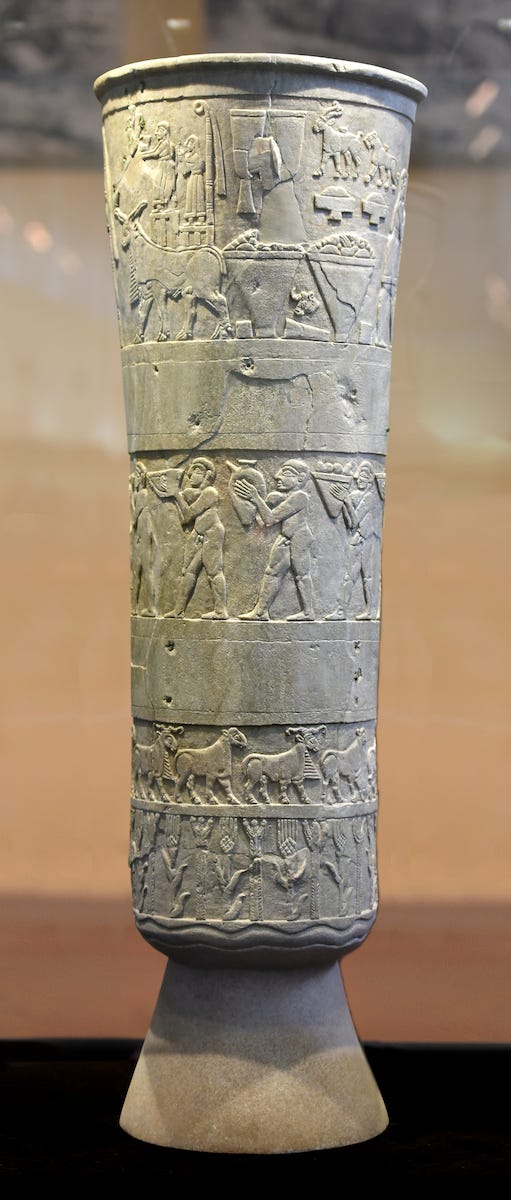
This is one of the most priceless treasures of the world, created more than five thousand years ago, around 3300 BCE, in Mesopotamia, now Iraq. And it’s a piece that shows us exactly why we’re in the mess we’re in today. It set us on a path to a world of climate change and petty dictators and tech bros aiming for Mars.
But it’s a miracle that we can even look at it today because the vase was almost lost forever. In 2003 when Americans invaded Baghdad, thieves rampaged through the museum, grabbing artifacts. They wrenched the vase up, all six hundred pounds of it, and cracked the top part from the foot, leaving the shattered foot toppled on the floor.1 Weeks later the museum offered an amnesty, no questions asked, for all its stolen treasures, and the story goes that three young men in a red Toyota drove up, opened their trunk, and hauled out several huge bundles wrapped in blankets. The vase was pieced together and placed atop its pedestal, and today it gives off a luster worthy of Venus.
And that’s because it created as an offering to Venus, whom the people knew as Inanna, Lady of the Heavens. They worshiped her as the bright star of morning and evening.
The world carved on the vase is one we can only imagine—a prehistoric world, just before the development of writing. It’s a story told in stone. But it’s one that unites heaven and earth. It’s a story that reflected the people like a mirror, but it also did something else, as all cosmic stories do. It created the people in its own image.
Today, more than five thousand years later, we can learn something of who those people were by studying their vase. But we can also learn something of who we are, for the story on that vase has created us as well.
Inanna, the patron of Uruk
In 3300 BCE the people of the city of Uruk worshiped Inanna, the Lady of Heaven, as the patron of their city. Inanna was the mystery behind all of life—the power swelling in the wombs of people and animals, the force that burst open a seed and lifted a sprout toward the sky. To keep Inanna happy, and to keep their own food flowing, the people tried to satisfy her every need. They grew enough food to support themselves and provide a surplus as well to devote to her temple.
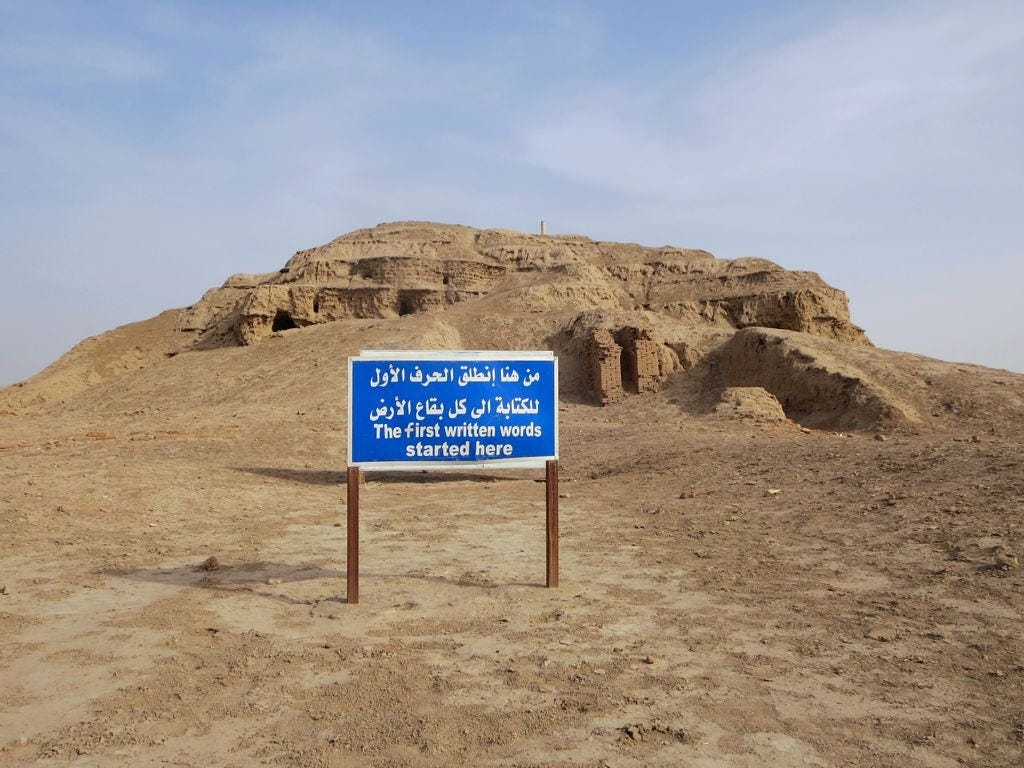
The temple was her home at the top of the city, the most lavish building imaginable, two stories tall. Its ceilings were formed of expensive timbers rafted down the river from the foothills far away. Its central hall could hold a congregation of hundreds.2 Her temple complex, a series of nine large buildings, held every luxury. It hummed with all the work of supporting her. Attendants roasted the best cuts of meat for her and wafted the rarest incense under her divine nose. They imported turquoise and gold from faraway lands. Just outside her house they planted a garden for her, an enormous sunken area surrounded by mosaicked benches and fed by an aqueduct.
And all these things they built on top of a huge, raised plaza called a ziggurat, like a city within a city, a spacious plaza elevated higher than any rooftops.
Inanna towered over their city. Look up, and she was there.
They had to keep her there, for their survival depended on it. If they let her wander away, the people would starve.
The images on the vase
The people of Uruk carved the story of their relationship with Inanna on the vase in a series of three bands, or tiers, up and down its sides.
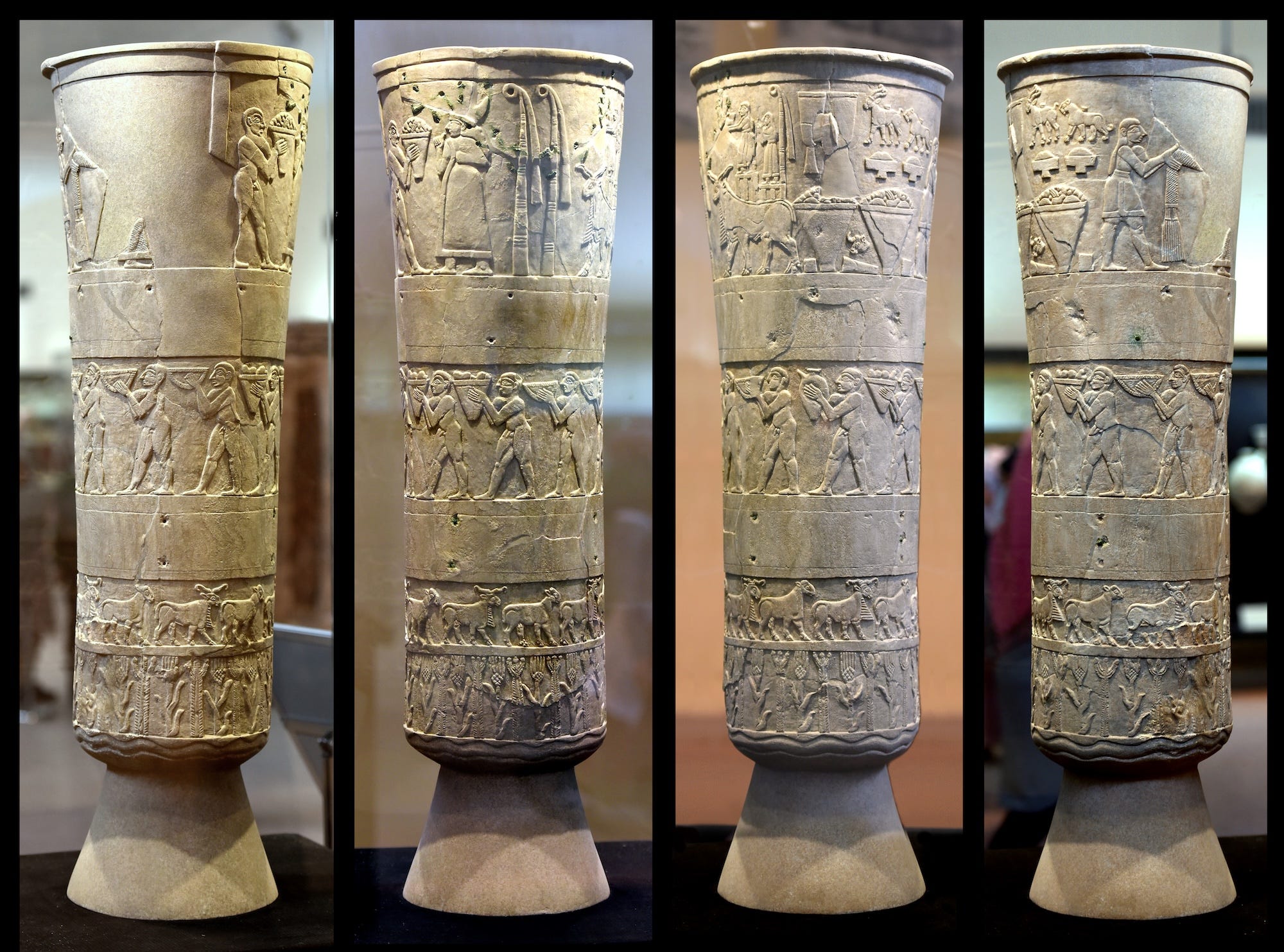
The goddess is there at the top, of course. You have to look up to find her there too. She3 is the woman in a long robe standing in front of two reed poles with flags, which you can see in the second of these four photos.
The poles behind her are the doors to her temple, which is actually a huge storehouse in the space behind her (in the third image) crammed with baskets of dates and bushels of grain and fat rams. Even more food is on the way, for in front of Inanna stands an attendant (you can see him in the first photo) handing her a basket of firstfruits. We are watching a harvest ritual to celebrate bringing in the food and presenting it to the goddess.
The figure behind the attendant is the most important man in the city, though today he’s just a big blank space (in the first photo). One corner of his long net skirt is visible, a skirt that only he wore to show his status and power. This is Inanna’s chief priest, the lord of the city. As the head of the temple, he is also the economic manager of the whole city, for the temple is the city government. The chief priest organizes all the work of growing the food and bringing it to the goddess.
Behind him another attendant holds one end of a long tasseled cloth (barely visible at the left edge of the first photo) that resembles the linen bedcovering a groom would give to his bride on their wedding day. For this harvest ritual is also a wedding—likely the shape of every marriage ceremony of the time, a groom approaching the door of the bride’s house bearing gifts.
Will she accept him? It depends on how lavish he is. How big is the harvest?
Which we can see in the second and third tiers below them. Around the vase in the middle tier flows a procession of men carrying the gifts of the earth—baskets of bread and bowls of fruit and bottles of oil and wine. They walk in lockstep, carrying a parade of food upward to the chief and the goddess. The harvest this year was a rich one.
Below the men, the bottom tier is shared by two layers, an upper one filled with animals and a lower one with plants. In the circle of animals, a ram and a ewe alternate around the vase, showing how fertile and healthy are the city’s herds. Below them two plants also join the procession, a stalk of barley, the staple of life, alternating with a date palm for sweetness. The plants are just as ordered as the animals, just as domesticated, for these two plants were the major crops of the city.
And finally, at the very bottom of the vase, in the tiniest space of all, two squiggly lines: the source of it all, water. The water that flowed in the river, giving life to their crops, their animals, themselves. The water the people devoted their lives to. Though devoted may not be quite the right word here. Because although their lives in this dusty land centered on water, the ancient inhabitants of Uruk did not serve water.
Instead, water served them.
The people of Uruk had mastered irrigation. They diverted water from the river through a dazzling array of irrigation canals and ditches and dikes and weirs to their fields and sheepfolds and gardens.
Water was the very foundation of the Uruk way of life. Water lay at the bottom of it all.
Making sense of the images
So what sense can we make of these pictures?
The first thing that jumps from the vase is the hierarchy. This is not a world where people and animals and earth share their gifts around the circle as a community of equals. This is an up-and-down world, where people look up to some and down on others. Where those at the top make decisions for others while those at the bottom are controlled, even enslaved. A world where there is no room for any kind of nature except the domesticated kind.
The goddess Inanna appears at the top not only because her home was in the skies but also because the people lived at her mercy. They once had depended on the heavens to send rain to grow their food—and the rains had been failing for a long time. Monsoons no longer reached their land. The soil was drying, and people far from the rivers could no longer grow food. Which is probably why the population of Uruk and every city along the rivers was exploding—tens of thousands of people following water. Migrating to the cities, where water was a sure thing. Where water was under control.
But living in the city meant giving up a great deal of freedom. Look at the men in the middle register, carrying the fruits of the earth upward. They are all stocky and muscular and identical except for their faces. And they are all naked, as the low-class working men of the time would have been, especially men who worked in the fields. Uruk needed massive amounts of labor to lay the bricks of the temples and dig the ditches and harvest the grain, and they taxed their citizens in labor. Each adult male was required to work for the city for a certain number of weeks or months each year, especially at harvest time. The stocky men on the vase are probably from that pool of unfree labor.
The animals and plants below them are also contained and controlled. The grain is tidy, the sheep are marching in order. This is efficiency on a massive scale, providing food and clothing for thousands.
And all of it is managed by the chief priest at the top of the vase. He’s portrayed there like a king, standing on a par with the goddess in her heavenly realm, sharing her domain—and also her bed. If the bride is pleased with his gifts, she will take him to herself and bless his government in the year to come.
The “natural” order of things
The story on the vase is a powerful one. Look at everything it pulls together: family, work, and food; plants, animals, and water; ritual, seasons, and stars; governance and belief—all of life.
And the up-and-down order is familiar to us even today: the heavens above, then humans next—always above animals and plants—then Earth at the very bottom. Aristotle put it in writing in 500 BCE as the Ladder of Nature, and it came down to us as the Great Chain of Being.
So let’s stop a moment here to appreciate how ancient this picture of things is. Aristotle was three thousand years removed from the vase; we think of him as lost in time, but we’re only twenty-five hundred years away from him. This chain of being is unimaginably old. People have been using this hierarchy to make sense of the world for a very long time.
What about that goddess?
There is one big difference, of course, between the Mesopotamian hierarchy and ours. On the vase the divine at the top is female. A goddess. But before we think this might have meant women had more power in Uruk, let’s look again.
The goddess on the vase is a bride, connected to a house. She may oversee the household, but she barely steps outside it. It’s her husband, the chief priest and lord, who runs the city. He brings the people’s food to her, and he brings it as a bride price at their wedding. It’s more like a feudal system, with the goddess receiving the bounty like the lady of the manor.
And where are the rest of the women of the city? Not another one appears on the vase. In other carvings from the time we do find women—women sitting in long lines making identical pottery or textiles, women looking for all the world like they are in workhouses on the first assembly line in history. Scholars think the women in those scenes were probably enslaved by the temple, maybe prisoners of war or women whose husbands had died so they had trouble getting food.
Because the family, for the people of Uruk, was a patriarchal one. Resources usually flowed down through the father to other family members.
And a good share of the men in Uruk—maybe the majority—received their food directly from the temple because they worked for the city. They tended fields or smelted copper or laid clay bricks, and the temple bureaucrats paid them in daily rations—bowls of grain handed out to all the workers.
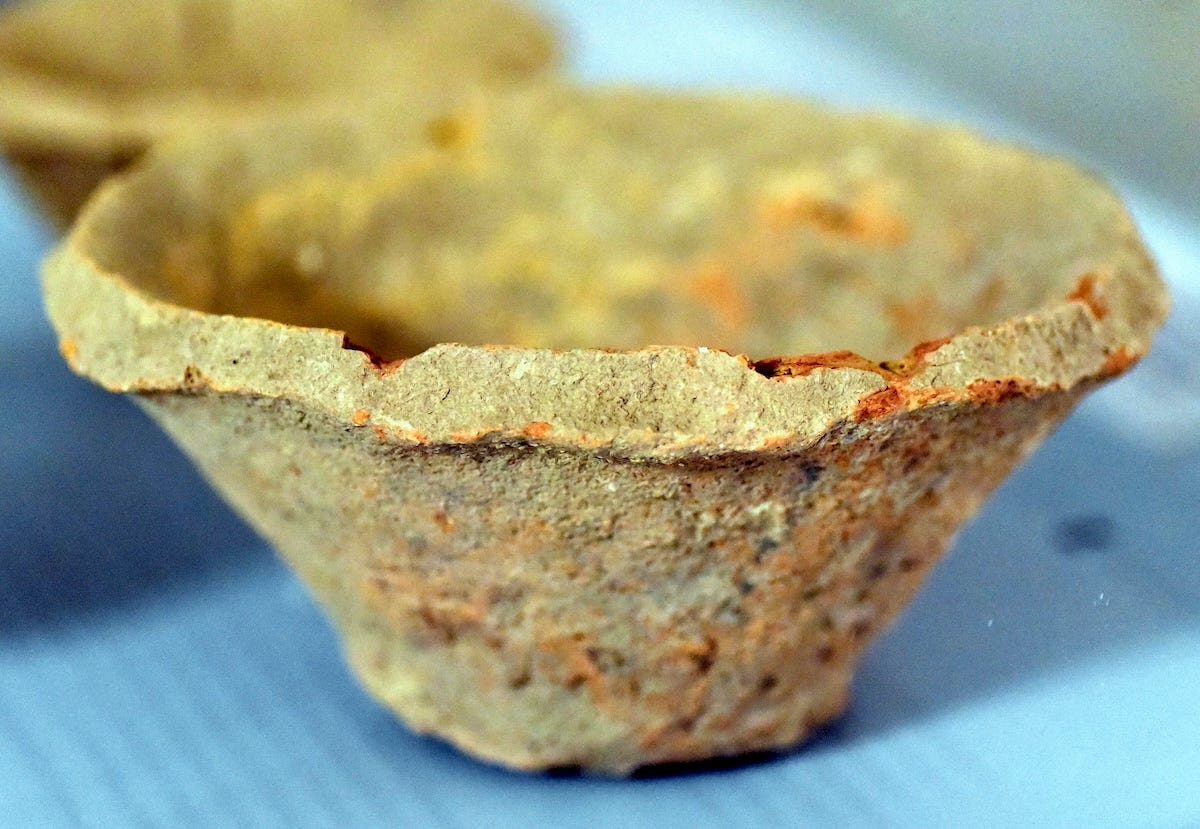
This would help to explain why there are tens of thousands of crude clay bowls littering the archaeological grounds of Uruk. They are rough bowls, mass produced and then thrown away. There is nothing fine about them. They hold about a liter of material, and it is thought they were the ration bowls, since each man who worked for the city was allotted about that much grain per day. Each woman received two-thirds that amount and each child worker even less. Because, yes, children too were enslaved, and some as young as six years old were made to work a full day like an adult.
If no human women appear on the vase, it leads me to ask, Since this was a public ceremony, and no women appear in the streets, does it suggest that women were supposed to stay close to their homes? Maybe even inside them?
Archaeology can provide a clue.
Excavations in villages of that region show that much, much earlier in time—several thousand years earlier—people in villages had cooked outdoors over shared fires and ovens. They would have been chatting with their neighbors and watching children together all day long. But about two thousand years before the rise of Uruk, or about 6000 BCE, the house plan in villages shifted. From then on, only one room of the house, the central hall, was connected to the outside. The cooking fire moved indoors, along with the other work that women did, like spinning and childcare. Women’s lives became more isolated, held within the walls of the house.
The goddess at the door of her home may show where the ideal woman belonged in the Mesopotamian hierarchy of things: as a wife, identified with her home, living close to its walls.
It is certainly true that the people of Uruk were trying to hold the goddess near so she would keep blessing them with food. All the rituals, all the luxuries were meant to keep her at home in their city. They were trying to domesticate the Lady of Heaven herself. So they pictured her as a modest wife in a long robe standing at the door of her house receiving food from her husband.
Through all their offerings, all their labor, the people of Uruk were trying to keep the untamed power of the heavens, the wild power of life itself, confined to her home.
Bureaucracy and writing
There are many other things to be said about the Uruk system. It was certainly efficient, but it took a lot of record keeping. So it was the bureaucrats of the city who developed writing, to keep track of storage jars and daily rations and numbers of workers. They pressed marks into wet clay to count and record it all. People in other parts of the world were inspired to write so they could follow the passing of time or record messages from the gods, but here in Uruk people developed writing for economic reasons. For accounting.
How hierarchy affects nature connection
But the main thing I want to say about the system of Uruk, as we can see it on the vase, is what it tells us about how hierarchy affects people in their connection with nature.
On the vase there are no forests or wild animals; there is no reverence for the landscape. This is not a story of celebrating the land. This is a story of dominating it. The relationships on the vase are relationships of control—over the workers in the fields, over the cultivated plants and enclosed animals, over water. Even the goddess, the very power of life itself, is domesticated.
In the story on the vase, controlling nature holds the key to human safety. As long as people can keep the irrigation systems running, the animals reproducing, the men harvesting, they can hold the world together.
But controlling the power of life, whether in the land or in other people, changes the fundamental human relationship with Earth. Because there is no such hierarchy in nature. And there is no such hierarchy in the natural state of human beings either. We come into the world absolutely alike, carrying nothing, and we leave it the same way. In the economy of Earth, everyone stands in the same relationship with nature’s gifts: everyone is worthy, able to receive what they need.
So when humans step away from this fundamental equality, both people and land are affected. Dominating other people always involves dominating land as well. When the Mesopotamians inserted powerful bureaucrats into the middle of the human-land relationship, giving a few men the power to control the food and work of others, they were affecting the land too. Because control is all of a piece. On the vase it flows smoothly down to animals and plants and land. The mistreatment of land and people makes up a single story.
And when others control our access to food or work, they are tampering with our most fundamental relationship with Earth. The food we eat is a gift from the Earth, created by the powers of sun and water and soil, not by any other human being. The clothing we wear comes from plants and animals whom the Earth makes to grow. These are gifts, made available freely by a giving Earth. How we use them and what we make of them through our own efforts and our own creativity is the gift each of us gives back.
Receiving our sustenance from the Earth and offering our work in return is the most fundamental, the most intimate, and the most sacred exchange we make with all the more-than-human others on Earth. People who insert themselves into the middle of this sacred relationship are stealing our own direct connection to the source. They are putting us in a juvenile relationship to life itself. Our connection to Earth—our ability to trade gifts directly with Earth—is severed.
The temple elite in Uruk who controlled access to the harvests of Earth were robbing others of their own direct connection to the land .
A society in which people do not share decisions about resources is a society that has already lost its connection to nature.
Receiving our sustenance from the Earth and offering our work in return is the most fundamental, the most intimate, and the most sacred exchange we make with all the more-than-human others on Earth.
This is a social problem, in that some have the power to control others, but it is also a spiritual problem, because a hierarchical system substitutes human power for the source. It trains people to think that other human beings provide their food.
We can watch it happening on the vase. The chief priest as manager and lord is standing on the level of the goddess rather than alongside other human beings. He is pictured as a being of the sky, dwelling above all others. His power is divine, ordained by the heavens.
Hierarchy and exploitation
Relationships of control are by definition exploitive. We can see it in Uruk in those ration bowls. When a woman spun wool into a finished cloth, and the cloth was then exported, she added a great deal of value to the raw material. Her work was more valuable, in fact, than the rations she received in return. The same was true for the ditch diggers and the field workers. The ration system of Uruk was wage theft on a grand scale. Those at the top were wringing others dry.
A society in which people do not share decisions about resources is a society that has already lost its connection to nature.
And they were doing it in order to scoop up a surplus so they could trade it abroad for more precious goods—more jewels for the temple, more copper for weapons to fight the city’s wars. The wealth they amassed may have belonged to the city as a whole, but in reality it benefited only a few.4 Only the temple personnel in their household high above the city poured libations from elegant amphora; it was rough clay bowls for everyone else. A hierarchy is a system that sends the resources upward to enhance the status and power of a few.
If the temple overseers had been content with having only as much as they needed rather than trying to wring out a surplus, they wouldn’t have had to work the land so hard. Irrigating the land year after year brings salts to the surface, and saltwater sterilizes the soil. So over centuries the soils of Mesopotamia lost their ability to grow food. Crop yields slowly decreased until they finally dwindled to nothing. The soil died.
Today the lands around what was once the great city of Uruk are full of drifting sands.
Trypillia culture
The thing is, the choices that the people of Uruk made were not the only choices available, not even at that time. Far away, northward across the Black Sea in what is now Ukraine, people at the exact same time were also living in large cities next to rivers, and their cities too numbered tens of thousands of people. Their culture also flourished for millennia.
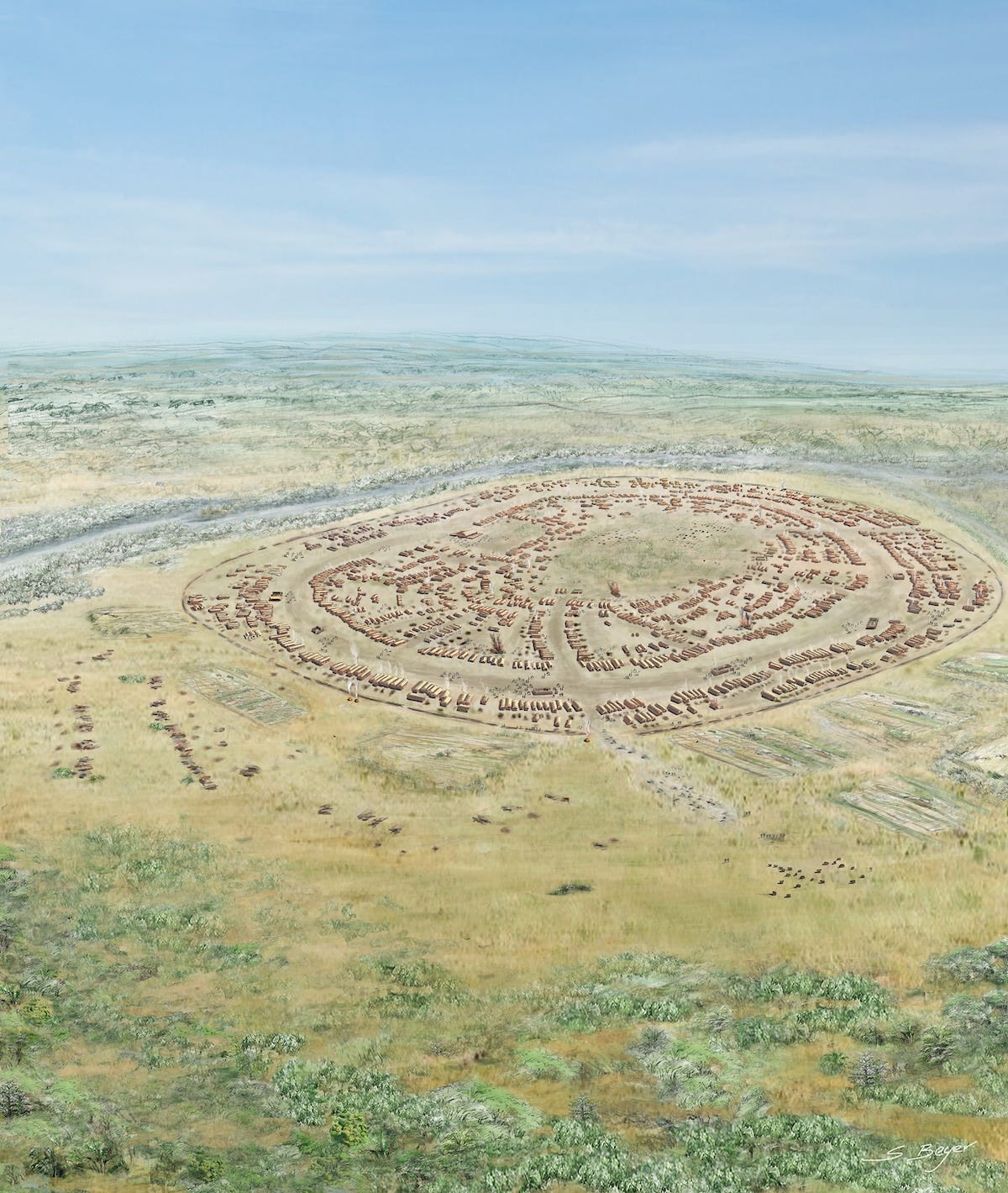
These were the people of the Trypillia culture, sometimes known as Old Europe.5 They also grew grain and raised farm animals, but they did it in ways that were adapted to their place. They communed with their land, in other words, instead of controlling it. They listened to what the land needed.
And it changed their relationships with each other. Archaeologists have found no markers of status in their cities—no oversized houses or prestige objects set aside in restricted buildings. Their relations were largely egalitarian. Instead of decorating a central house, people often painted designs on individual houses. Instead of reserving precious pottery for the elite, they decorated all their pottery with exquisite patterns. And they are known especially for the female figurines they carved, found in the archaeological ruins of many homes. Did they too worship female powers?6 We don’t know. Certainly they were intrigued by female bodies and their abilities to bleed and give birth. What we do know is that in their cities, art and decoration and figurines were spread throughout the community; everyone got to use fine things and enjoy them.
And although the people of the Trypillia culture also farmed intensively—so intensively that the ancient forests of their lands died out and never returned—they did not wear out the soils of their place. In the centuries to come, their cities would be covered by the great grasslands of the Ukrainian steppe.
The power of a story
It is telling, I think, that the model of culture that has been handed down to us is the one from Uruk—patriarchal, hierarchical, and exploitive—rather than the one from Ukraine. Uruk pioneered the Way of Empire, passed down to us through all the empires that followed—Egypt and Persia, Rome and Europe and Britain. We have been indoctrinated to think of Uruk as the only model for “civilization.” As if exploitation and enslavement are just the price we have to pay for beautiful things. As if controlling nature and people is the sign of cultural progress.7
The Trypillian cities show us just how much of a lie that is.
The story on the Uruk vase is gobsmackingly familiar today. Our lives still follow its outlines to an astonishing degree. A small elite controls access to the gifts of the Earth and decides the priorities they will be used for. A few people commandeer our time and decide what we will work for. And the things they choose are things that actually harm life on Earth, such as weapons systems and private jets and colonies on Mars.
Today we also have a class of temple overseers—we call them shareholders and big banks—who don’t do the actual work but are allowed to collect the profits anyway. And we have an economic order, now worldwide, that is killing the land for more stuff to satisfy the whims of the few.
What is the answer?
What is the answer? It’s always two things—and these two things always go together:
(1) We have to change the story, and
(2) we have to change the rules.
Changing the story is an inside job. Each of us does it first inside ourselves. It means noticing whenever we give wealth a pass, whenever we’re tempted to think that rich people did something—anything—to deserve more than others.
They didn’t. And they don’t.
People who study the Trypillia culture agree on one thing: the equality they practiced does not happen by itself. A community has to choose it. They have to value it, and they have to tell themselves stories that value it—stories that teach them how to treat each other fairly, how to be generous, how to be happy with just enough.
But hierarchy is a choice too. It doesn’t happen “naturally.” It takes a few people deciding to keep more for themselves, and it takes the rest of the community acquiescing—telling stories of “better” and “worse,” “deserving” and “undeserving.” Once a story of hierarchy has taken root, it is awfully hard to yank up, as we can see in our time. But we also can see right where this story ends—in such disregard for the life-giving ability of the Earth that we destroy the very conditions that brought us into being.
So we have to do the outside job too: we have to change the rules. We have to make massive accumulation of wealth impossible. It is incompatible with freedom. I’m reminded of the saying attributed to Justice Louis Brandeis: “We can have democracy in this country or we can have great wealth concentrated in the hands of a few, but we cannot have both.”
Today there may be democracy in the voting booth, but there is none in the economy. We have to choose democracy in our workplaces too. We have to choose it in all our trades and transactions. It means, for starters, changing the rules to reward reciprocity instead of profit.
The Great Turning
It is no wonder that today battle lines in the culture wars are so starkly drawn. A story told five thousand years old has only, in the last several hundred years, lost its grip. Most of human society is straining forward to move beyond it, but the powerful and their allies will not surrender it easily. To them it still looks like the natural order of things. It was, after all, written in stone. Egalitarian relations among Western people are brand-new compared to how long the story of hierarchy has been operating.
To be born at a time when an ancient story of domination is dying is an amazing privilege. Joanna Macy called our time the Great Turning, the most exciting possible time in which to live. We have the chance to do something radically different. An old paradigm has lost its power, and the door of history is opening. We have a chance to step through and explore the world on the other side.
In this new world, everyone can thrive. It’s a world where we can hear the voices of our more-than-human relatives and where we shape our lives to include their needs. Where we can share the gifts of Earth with one another. Where we can solve huge problems together because we are listening to one another.
This is not a fantasy. Many peoples throughout human history have chosen this kind of world for themselves. Native nations of North America threw off their oligarchs some eight hundred years ago to live in more egalitarian communities. Choosing equality may be hard, it may take many generations, but it is possible.
The great writer and activist Arundhati Roy once told a stadium of tens of thousands of people, “Another world is not only possible, she is on her way. On a quiet day, if I listen very carefully, I can hear her breathing.” At the end of her speech, it is said, the stadium fell into a profound silence.
Wishing you enough silence to hear the sweet breathing of a new world.
Update June 5: The Global Justice Report just came out, authored by economist Thomas Piketty and 44 others at the World Inequality Lab.
Their message? "An equal and habitable world is possible." And they have specific proposals for getting there. The Guardian covers the report.
Yes, this is possible!
If you’re reading this, thank you so much for your generous attention! This is a longer-than-usual post, so I’m grateful you’re still here. What interested you the most? Which parts of Uruk, if any, seem familiar to you? Had you heard of the Trypillia culture? My impression is that most people haven’t. To me, something about the 5000-year time line of hierarchy is significant. The long-term perspective gives me hope that our present struggles are just the beginning of a growing wave toward a freer and fairer world. Your impressions? Let us know in the comments!
If you gained something from this post, please feel free to let me know this way too:
And don’t forget to hit LIKE before you go!
For digging deeper
The sources on Uruk and ancient Mesopotamia are legion. The best one-stop overview is Gebhard Selz, “The Uruk Phenomenon,” The Oxford History of the Ancient Near East, Vol 1: From the Beginnings to Old Kingdom Egypt and the Dynasty of Akkad, edited by Karen Radner, Nadine Moller, and D. T. Potts (Oxford University Press, 2020), 163–244.
Other sources used for today:
Englund, Robert K. “The Smell of the Cage.” Cuneiform Digital Library 4 (2009). Archaeological and textual evidence of child labor in Uruk.
Liverani. Mario. Uruk: The First City. Edited and translated by Zainab Bahrani and Marc Van De Mieroop. Equinox, 2006. Especially good for visualizing the agricultural system, irrigation, and mandatory labor.
Nissen, Hans J. From Mesopotamia to Iraq: A Concise History. Chicago: University of Chicago Press, 2009. First chapter covers the ecology and landscape of the area at the time of the Uruk vase. Available at the Internet Archive.
Pollock, Susan. Ancient Mesopotamia: The Eden That Never Was. Cambridge University Press, 1999. Accessible yet in-depth archaeological evidence to reconstruct Uruk city life. Includes photos of the desertification of lower Mesopotamia because of salinating the soil through irrigation.
Pollock, Susan, and Reinhard Bernbeck. “And They Said, Let Us Make Gods in Our Image: Gendered Ideologies in Ancient Mesopotamia.” In Reading the Body: Representations and Remains in the Archaeological Record, edited by Alison E. Rautman, 150–64. University of Pennsylvania Press, 2000. Includes sketches of the images of women in factory settings carved at the same time as the vase.
Scott, James C. Against the Grain: A Deep History of the Earliest States. Yale University Press, 2017. From the publisher’s summary: “The first agrarian states, says James C. Scott, were born of accumulations of domestications: first fire, then plants, livestock, subjects of the state, captives, and finally women in the patriarchal family—all of which can be viewed as a way of gaining control over reproduction.”
Ur, Jason. “Households and the Emergence of Cities in Ancient Mesopotamia.” Cambridge Archaeological Journal 24, no. 02 (June 2014): 249–68. Shows how Uruk and other early city-states were modeled on the family unit and the temple was built on the floor plan of the family home.
Wengrow, David. “The Changing Face of Clay: Continuity and Change in the Transition from Village to Urban Life in the Near East.” Antiquity 72 (1998): 783–95. Archaeological evidence showing how the house shape in Mesopotamian villages during the Ubaid period (the period prior to Uruk) changed so that women’s work moved indoors.
On Cucuteni-Trypillia culture: the Wikipedia article is a great place to start. Other sources used today:
Chapman, John, Bisserka Gaydarska, and Marco Nebbia. “The Origins of Trypillia Megasites.” Frontiers in Digital Humanities 6, no. 10 (May 31, 2019).
Graeber, David, and David Wengrow. The Dawn of Everything: A New History of Humanity. Farrar, Straus and Giroux, 2021.
Hofmann, Robert, Nils Müller-Scheessel, Johannes Müller, “Trypillia Mega-Sites: A Social Levelling Concept?” Antiquity 98, no. 398 (April 2024): 380–400.
Müller, Johannes, Knut Rassmann, and Mykhailo Videiko, eds. Trypillia Mega-Sites and European Prehistory, 4100–3400 BCE. Themes in Contemporary Archaeology 2. Routledge, 2019.
How do we fix inequality? For an eye-opening conversation, see Michael Mezzatesta’s interview with Olivier De Schutter, UN Special Rapporteur, “Our Economy Creates Poverty and Panders to the Rich. Here’s How to Fix It,” on his Better Future Substack, May 13, 2026. In another terrific conversation, economist Jason Hickel explains how we have no democracy in our economy, despite the fact that most people want it and support it; see “Why Capitalism Can’t Save Us,” Better Future, July 31, 2025.
The Inequality.org website has a wealth of information: statistics on inequality, strategies for building equality, what actions people are already taking.
For an inspiring talk from Joanna Macy, see this 2002 event: “The Great Turning,” Salt Spring Island, BC.
For a fantastic, readable story of how the Native nations of North America overthrew their priestly class in 1200–1400 CE, based on all the best archaeological and narrative evidence, see Katherine DuVal, Native Nations: A Millennium in North America (Random House, 2025). Stephen Carr Hampton writes about it in his post, “The Ivorybill Revolutions,” Substack, May 29, 2026.
Arundhati Roy’s words come from a speech she gave to a stadium of people in Brazil in 2003, reported by Naomi Klein in the Foreword to The Chequebook and the Cruise Missile: Conversations with Arundhati Roy. Interviews by David Barsamian (Harper Perennial, 2004), xii. At the end of her speech, Klein said, “That stadium has never heard silence like that.” The book is available at the Internet Archive.
For a photo of the toppled base, go to “Warka Vase” at Smarthistory: The Center for Public Art History.
For a reconstructed interior view of a similar temple, see “White Temple and Ziggurat, Uruk” at smarthistory.org.
Or her high priestess.
They privatized the gifts of the Earth without a concept of private property.
Or Cucuteni-Trypillia culture.
Archaeologist Marija Gumbutas and some other feminist scholars thought so, and their writings inspired the Goddess movement. But other feminist archaeologists, such as Meg Conkey, argued—more in line with the evidence, I think—that we just don’t know.
Also, in the academic world Uruk is called a “city” but a Trypillian settlement is called a “mega-site” because it’s considered less “complex.” But as Graeber and Wengrow ask in The Dawn of Everything: “Why do we assume that people who have figured out a way for a large population to govern and support itself without temples, palaces and military fortifications—that is, without overt displays of arrogance, self-abasement and cruelty—are somehow less complex than those who have not? Why would we hesitate to dignify such a place with the name of ‘city’?” (290).


.jpg)